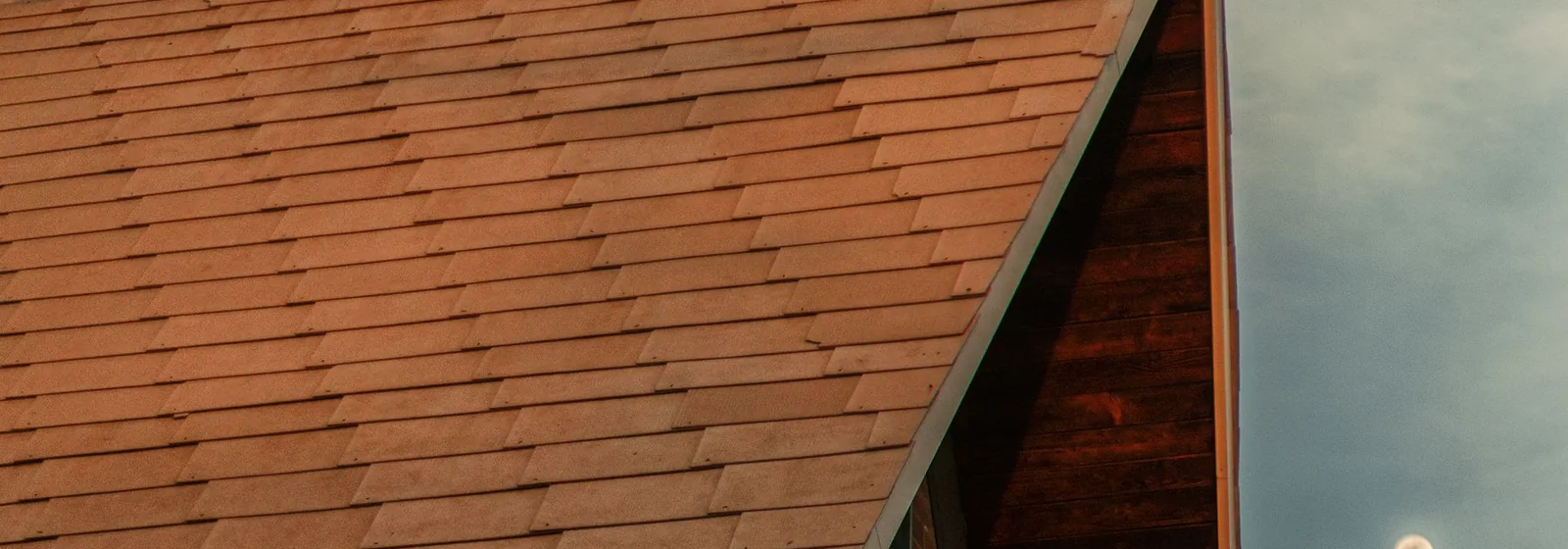
Most U.S. pitches are written per 12 inches of run.
Enter your measurements and tap Calculate to see the result.
How to measure
Pitch is the rise over run (definition) of the roof. The usual method is to measure how many inches the roof rises over 12 inches of horizontal run. In an unfinished attic, set a level along the bottom of a rafter, bring it level, and measure the rise at the 12-inch mark. From a drawing, divide the total rise of the rafter by its rafter run (definition) and multiply by 12. Avoid walking a steep or wet roof to take this measurement if you are not equipped and trained to do it safely.
What the numbers mean
The calculator turns your rise and run into three useful figures. The angle in degrees is arctangent(rise ÷ run). The slope percent is (rise ÷ run) × 100, so 6:12 is a 50 percent slope. The pitch multiplier (definition) is the square root of 1 + (rise ÷ run)². Multiply a plan, or footprint, area by that multiplier to get the slope area. For one plane, slope width = plan width × multiplier, and area = length × slope width.
Worked example: a 6:12 pitch has a multiplier of √1.25 ≈ 1.118. A gable whose two plan halves are each 40 feet long and 15 feet wide has a plan area of 1,200 square feet and a roof surface of about 1,341.6 square feet. The same house written as 40 × 30 feet of footprint, plus overhangs, is the starting point in the roof area calculator.
Common residential pitches and their multipliers, from the same formula: 3:12 ≈ 1.031, 4:12 ≈ 1.054, 5:12 ≈ 1.083, 6:12 ≈ 1.118, 7:12 ≈ 1.158, 8:12 ≈ 1.202, 9:12 ≈ 1.250, 10:12 ≈ 1.302, 12:12 ≈ 1.414. These are geometry, not product ratings. Results are planning estimates. Confirm coverage, nail patterns, and installation details with the manufacturer's instructions, and check your local building code. This tool is not a substitute for a licensed roofer or a permit review.
How do I convert roof pitch to degrees?
Roof pitch is written as rise over run, usually inches of rise in 12 inches of run. The angle in degrees is the arctangent of rise divided by run: a 6:12 pitch is about 26.6°, and a 12:12 pitch is 45°. The pitch multiplier — the number that turns a flat footprint into sloped surface area — is the square root of 1 + (rise/run)². For 6:12 that multiplier is about 1.118, so 1,000 square feet of footprint becomes about 1,118 square feet of roof. Enter a rise and run above, or use the roof area calculator to apply the multiplier to a building footprint.
Frequently asked questions
What is a 6:12 pitch in degrees?
A 6:12 pitch rises 6 inches for every 12 inches of horizontal run. The angle is the arctangent of 6 ÷ 12, which is about 26.57 degrees. The pitch multiplier is the square root of 1.25, about 1.118.
How do I measure pitch from the ground or the attic?
In the attic, hold a 12-inch level along the underside of a rafter, level it, and measure the vertical rise at the 12-inch mark. That rise, in inches, is the first number in a rise-over-12 pitch. On the roof, a pitch gauge can do the same job. Work only from a stable position, or have a licensed roofer measure it.
Does pitch change how many shingles I need?
Pitch changes the surface area if you started from the building footprint. A 6:12 roof has about 11.8 percent more surface than its plan area; a 12:12 roof has about 41.4 percent more. If you already measured the planes on the roof, pitch is already in those numbers.
What pitch can asphalt shingles be used on?
GAF’s Timberline NS instructions require a slope of 2:12 or greater. Low-slope roofs often need a different underlayment or a different roof system. Follow the shingle maker and your local code.
What is a 4/12 or 8/12 roof pitch in degrees?
A 4:12 pitch is about 18.4 degrees; an 8:12 pitch is about 33.7 degrees. Enter the rise and run above to see degrees, slope percent, and the multiplier, then take the multiplier to the roof area calculator if you are converting a footprint into squares.
Results are planning estimates. Confirm coverage, nail patterns, and installation details with the manufacturer's instructions, and check your local building code. This tool is not a substitute for a licensed roofer or a permit review.
Related calculators
Sources
- The pitch multiplier and degree conversion are standard right-triangle geometry: multiplier = √(1 + (rise/run)²); degrees = arctan(rise/run).
- GAF, Timberline NS installation instructions: shingles must be installed on slopes of 2:12 or greater.