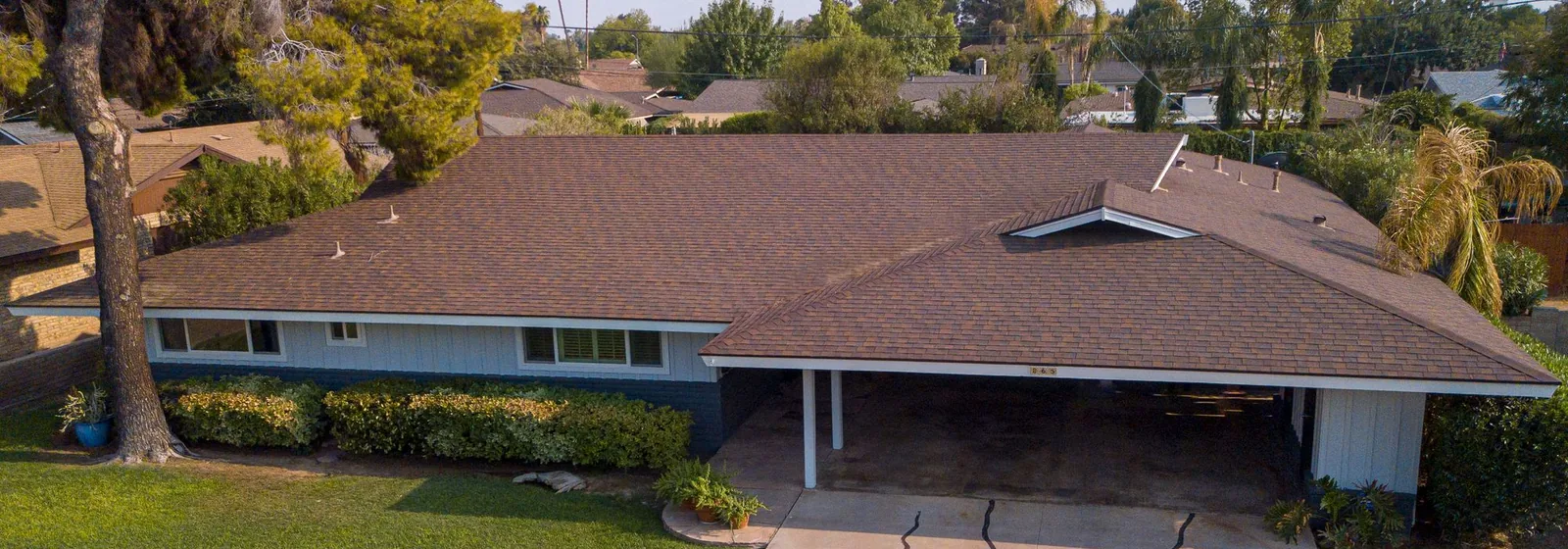
For a simple gable or hip with one pitch, the calculator multiplies the plan area (the footprint plus overhangs) by the pitch multiplier. Dormers and extra wings should be added as separate planes.
Enter each roof plane. Choose “measured on the roof” if the width already follows the slope, or “plan width and pitch” if you measured the horizontal width on the ground or a drawing.
Owens Corning suggests 10–15% for trim; use more on a cut-up roof.
Enter your measurements and tap Calculate to see the result.
How to measure
You can start from the house footprint or from measurements taken on the roof. For a simple gable, measure the length and width of the building, add the overhangs, and enter the roof pitch (definition). The calculator multiplies that plan area by the pitch multiplier (definition) to get the slope area. If you can safely measure on the roof, or from a trusted drawing, enter each plane’s length and the width along the slope, and the pitch is already included in those numbers. Add dormers and extra wings as their own planes, then add a waste allowance for cuts.
How this shingle calculator works
Roofing materials are sold by the roofing square (definition): 100 square feet of roof surface. After the area is known, the calculator adds your waste percentage and divides by the coverage on the shingle wrapper. The default is the published figure for GAF Timberline NS and Owens Corning Oakridge architectural shingles: 3 bundles (definition) cover 98.4 square feet, with 64 shingles and 256 nails at 4 nails each. Choosing the six-nail option keeps that coverage and uses 6 nails per shingle, which is 384 nails per product square.
Formulas: roof squares = surface area ÷ 100. Order area = surface area × (1 + waste ÷ 100). Bundles = order area ÷ (coverage ÷ bundles per square), rounded up. Field nails = pieces × nails per shingle, with pieces also rounded up.
A worked example, using Owens Corning’s 40-by-30-foot gable (two slope planes, 2,400 square feet) and a 10 percent waste allowance: the order area is 2,640 square feet, which is 26.4 roofing squares. Coverage is 32.8 square feet per bundle, so 2,640 ÷ 32.8 ≈ 80.49, which rounds up to 81 bundles. At 4 nails per shingle, the nail count is 64 pieces per 98.4 square feet of product, rounded up, times 4.
These defaults are a starting point, not a substitute for the wrapper in your hand. Some three-tab and designer shingles use a different bundle count or coverage. If your product is not listed, choose Custom and type the coverage and nail pattern from the label. Results are planning estimates. Confirm coverage, nail patterns, and installation details with the manufacturer's instructions, and check your local building code. This tool is not a substitute for a licensed roofer or a permit review.
How many bundles of shingles do I need?
Start with the roof’s surface area, not the house’s floor area. A roofing square is 100 square feet of surface. GAF Timberline NS and Owens Corning Oakridge architectural shingles are packaged at 3 bundles per product square and cover 98.4 square feet when applied as directed, so you need a little more than three bundles for each 100 square feet of roof, plus a waste allowance. Owens Corning’s re-roofing guidance uses 10 to 15 percent extra for trim and cuts, and more on a complicated roof. Use the calculator above, or start with the roof area calculator if you only have the building footprint. Starter strip and ridge cap are counted separately in the ridge cap and starter calculator.
Frequently asked questions
How many bundles of shingles are in a square?
For GAF Timberline NS and Owens Corning Oakridge architectural shingles, 3 bundles cover 98.4 square feet, which the manufacturers treat as one product square. A roofing square of roof area is still 100 square feet, so you need a little more than 3 bundles for each 100 square feet of roof. Read the wrapper; some products differ.
How much waste should I add?
Owens Corning’s re-roofing guidance uses 10 to 15 percent extra for trim and cuts, and notes that a more complicated roof needs a higher waste factor. This calculator defaults to 10 percent, which you can raise for hips, valleys, and dormers.
Why is the bundle count higher than squares times three?
Because these architectural shingles cover 98.4 square feet per three-bundle square, not a full 100. A 2,400-square-foot roof with no waste is 24 roofing squares, but 2,400 ÷ 32.8 is about 73.17, which rounds up to 74 bundles, not 72.
How many nails do I need?
GAF lists 256 nails per square for Timberline NS, which is 4 nails on each of 64 shingles. Steeper slopes and some enhanced wind-warranty applications require 6 nails per shingle, or 384 nails per product square. Use the pattern in the installation instructions.
How many shingles do I need for a 2,000 square foot house?
The 2,000 square feet is usually the finished floor area, not the roof. A one-story house that size with a 6:12 pitch and 1-foot overhangs has more than 2,000 square feet of roof surface. Start with the roof area calculator, then come back here to convert that surface into bundles and nails. Starter strip and ridge cap are counted separately in the starter and ridge-cap calculator.
Results are planning estimates. Confirm coverage, nail patterns, and installation details with the manufacturer's instructions, and check your local building code. This tool is not a substitute for a licensed roofer or a permit review.
Related calculators
Sources
- GAF, Timberline NS specifications: 3 bundles/square, 64 pieces/square, 256 nails/square, 5⅝-inch exposure.
- GAF, Timberline NS installation instructions (RESTL623, Aug. 2023): 3 bundles (one of 20 and two of 22) cover 98.4 sq ft when applied as directed.
- Owens Corning, Oakridge shingles technical characteristics: 3 bundles per square, 64 shingles per square, 98.4 sq ft coverage per square.
- Owens Corning, “DIY Roofing: Re-Roofing Tips” (published Oct. 11, 2023): a roofing square is 100 sq ft; laminate shingles are generally 3 bundles per square; add 10–15% for trim allowance, more on a complicated roof.